Aluminium pool fencing in Wagga: flat-top and tubular
Aluminium pool fencing in Wagga is usually sold as flat-top or tubular panels. Those are the names suppliers use, not terms from a regulator, so ask the contractor to describe the panel you are quoted. Suppliers list several powder-coat colours. We are a referral service: we pass your enquiry to a local contractor, who supplies and fits the fence and answers for the work.
This page covers what to ask about the panel, the few council statements that matter most for aluminium, and what moves the cost. It cannot say which edition of AS 1926.1 your fence is built to, and it cannot say which licence or registration the work needs. Both are open questions, and for both you ask.
Flat top pool fence or tubular: choosing a style
The choice between a flat top pool fence and a tubular one is partly about looks and partly about what the contractor stocks. The council page lists gaps, gates and what stands near the fence among the things it checks. So the useful questions are about the product, not the name:
| Ask about | Why it matters |
|---|---|
| The panel's data sheet | It describes the product the contractor intends to fit. Keep a copy with the quote. |
| Any test report offered | It shows what the product was tested for. We do not name a certification mark, because we found no regulator page that does. |
| Spacing of pales and rails | The council page lists gaps and rail spacing among the figures it checks. See below. |
| The gate and its hardware | The gate is part of the barrier, and the council page lists how it closes and latches. |
| Colour, including a black pool fence | Suppliers list several powder-coat colours. Ask what the finish is and what the warranty terms say, in writing. |
| Which edition it is designed to | Ask who certifies it as well. See the edition note below. |
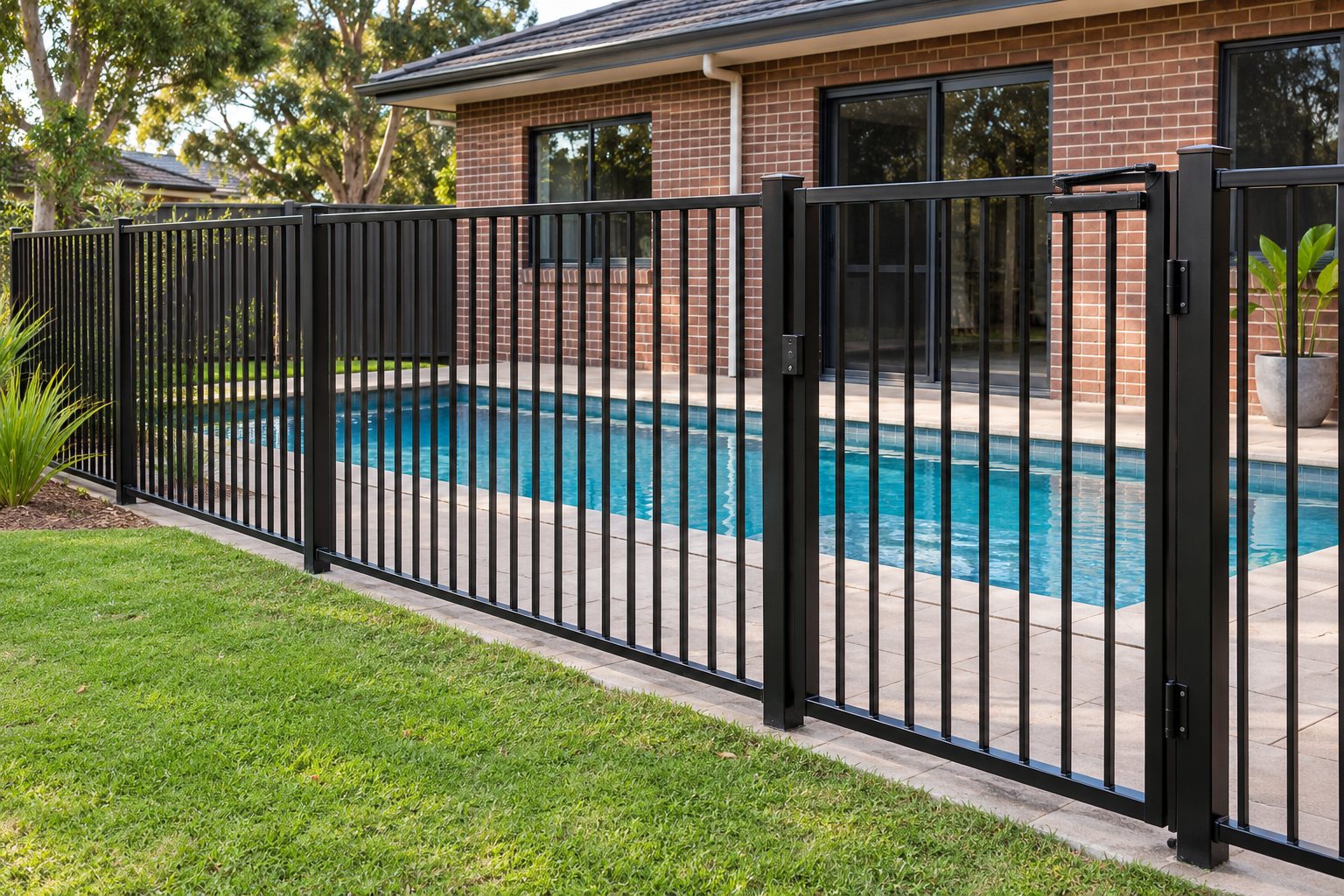
What the Wagga council page says about gaps and rails
The Wagga council page gives a short list that bears directly on aluminium panels. It says gaps between components of the barrier should be no more than 100 mm, horizontal components at least 900 mm apart, and a boundary fence that forms part of the pool fence 1.8 m high, measured from inside the pool enclosure. These are the figures on the Wagga council page, which is the edition the council pages cite (AS 1926.1-2012). A 2024 edition has been published and no NSW page we found says which edition a certifier applies to a new fence today. Ask the council or your certifier before you buy or build.
The height, gaps and gates page has the full list and the timeline of what each source says. Heights and spacings are not the only thing checked. The council page also says no barbecues, furniture, planter boxes, trees or shrubs should be within 900 mm of the fence, and the Wagga policy says no part of a privacy screen should sit in the zone. The non-climbable zone page explains what that means beside an aluminium fence.
Gates on an aluminium fence
The Wagga council page says gates must open outwards and be fully self-closing and self-latching. A gate is part of the barrier, so adding one to an existing aluminium fence is a question for the council or your certifier as well as the contractor. This site gives no latch figures, because sources differ and the council page also sets a minimum latch height for pool doors. If a gate has stopped latching, the repairs page covers what the council's maintenance list names.
Aluminium as a boundary fence
If a side boundary fence forms part of the pool barrier, the council page gives the 1.8 m figure above. Legal Aid NSW says the usual sharing of a dividing fence does not apply to a pool barrier, so the pool owner pays. A 2013 barrier book prepared for NSW councils, which cites the 2012 edition, says gates within a boundary fence are not acceptable. That is an older document, so treat it as a prompt to ask, not as the current answer.
Earthing, data sheets and what to ask
Ask the contractor whether earthing needs to be considered near a metal fence. We found no regulator page on it, so we do not state a rule. Ask too for the product's data sheet and any test report, and ask which edition of the standard the fence is designed to and who will certify it. For background on why the edition question exists, an HIA article on the revised AS 1926.1 says the 2024 edition is referenced in NCC 2025 and currently applies in Victoria. Our page on glass, aluminium or mesh compares the options if you are still choosing.
What moves the cost of an aluminium fence
This site does not publish prices. The things that move a quote are the length and number of corners, the panel and its specification, the number and type of gates with their hinges and latch, whether an old fence has to come out, the ground (concrete, pavers, a bank or slope, core drilling or plates), any boundary fence or non-climbable zone work, and certification and inspection fees. Ask what the quote includes and who arranges the certificate. The cost guide goes through each driver.
Licensing depends on the type and value of the work. The regulator pages we found do not say which category covers fitting or repairing a pool fence. Ask the contractor which licence or registration they hold, check it on the NSW licence check, and ask Building Commission NSW if you are unsure. For local housing facts, see the city page, and to start an enquiry use the contact page.
What this page cannot do
This page cannot tell you which edition of AS 1926.1 applies to your fence, whether a particular panel suits your pool or whether your fence will pass an inspection. The council or your registered certifier decides. It cannot say which licence or registration covers the work, because the NSW pages do not settle it. It cannot give a price, name a certification mark or say whether earthing applies to an aluminium fence. For those, ask the council, the certifier and the contractor.
Check the current rules before you rely on this
This page describes aluminium pool fencing and what the Wagga council page, the NSW Government and other sources say about the parts a certifier checks. It describes the rules in general terms as they stood in November 2026. Standards, forms, thresholds and fines change.
The authoritative sources are Wagga Wagga City Council, pool fencing requirements, NSW Government, owning a pool or spa: your obligations (updated 16 March 2026), Pool Safety Barrier Book NSW, prepared for NSW councils (version 2, 2013; flag: older, cites the 2012 edition), HIA, swimming pool barriers and the revised AS 1926.1 and Legal Aid NSW, fences, boundaries and retaining walls FAQs. Where anything here differs from those sources, they are right and we are not.
We are not pool fencing contractors, certifiers, builders, regulators or lawyers. For what applies to your pool, ask Wagga Wagga City Council or your certifier which rules and which edition of the standard apply, ask the contractor which licence or registration they hold, and ask Building Commission NSW if you are unsure about licensing.
Accurate at the time of writing, November 2026. Always check the source before relying on it.