The non-climbable zone: what the council page says
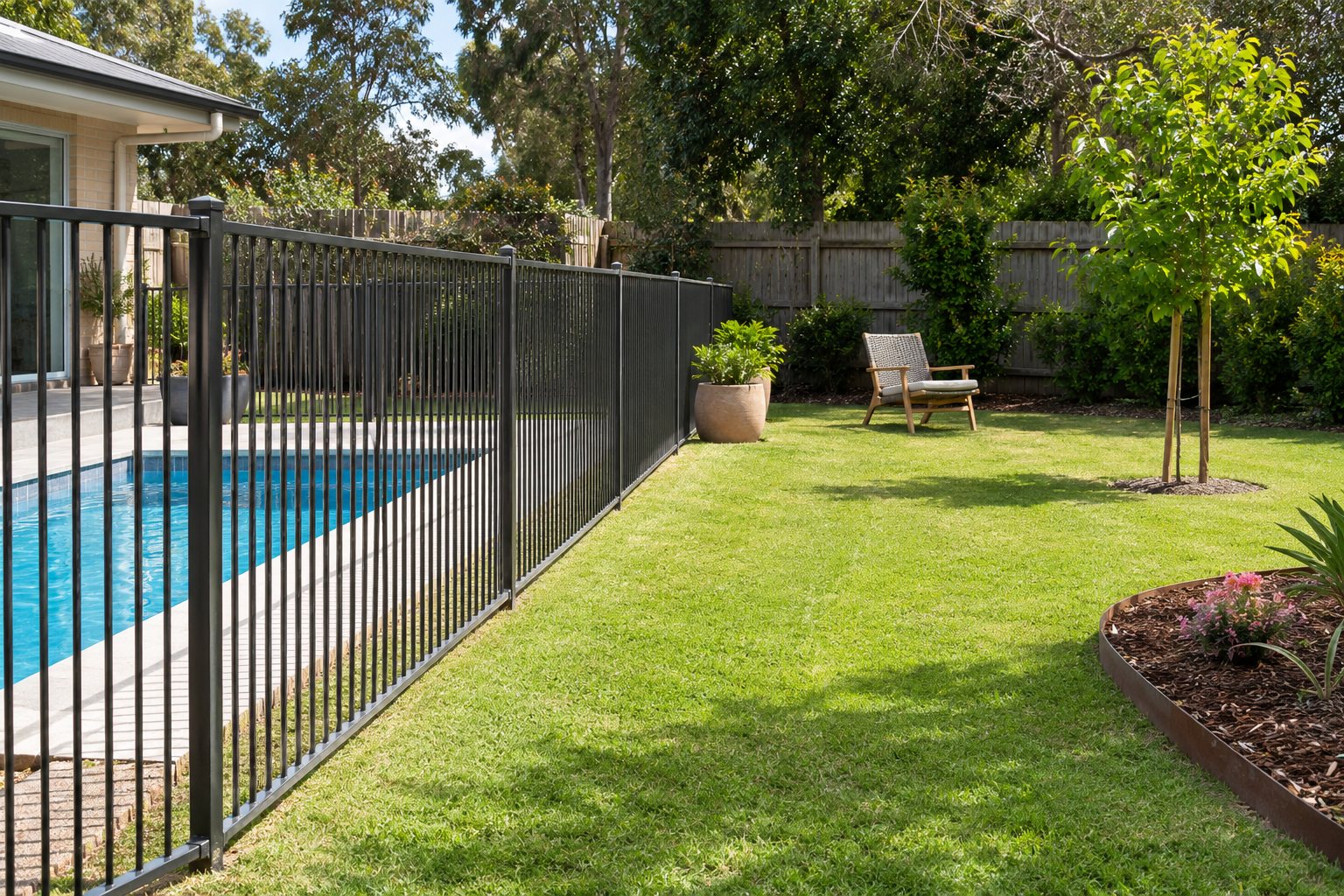
The non-climbable zone is the strip around a pool fence kept free of anything a child could use to climb over. The Wagga council page says there should be no barbecues, furniture, planter boxes, trees or shrubs within 900 mm of the fence, and that the zone extends 300 mm into the pool area and 900 mm outside it. The NSW owner page says to keep a 90 cm zone clear of objects such as furniture, plants and toys. The Wagga figures are from the edition the council pages cite, AS 1926.1-2012, and the 90 cm figure is the NSW owner page's own wording. A 2024 edition has been published, and no NSW page we found says which edition a certifier applies to a new fence today. Ask the council or your certifier which zone applies to your fence before you plant, build or buy.
What counts as a climbable object
The council pages we found name ordinary things: furniture, pot plants, barbecues, trees, shrubs, toys and ladders. The table shows who says what.
| Source | What it says | Note |
|---|---|---|
| Wagga council fencing page | No barbecues, furniture, planter boxes, trees or shrubs within 900 mm of the fence. The zone is 300 mm into the pool area and 900 mm outside | Cites the 2012 edition |
| Wagga policy POL 049 | No part of any privacy screen within the 900 mm non-climbable zone | Approved 17 October 2022; check for a newer version |
| NSW owner obligations page | Keep a 90 cm zone clear of objects such as furniture, plants and toys | Updated 16 March 2026 |
| Another NSW council's page | Zones must stay free of climbable objects such as furniture, pot plants, barbecues, trees, shrubs, toys or ladders | Another council; illustrative |
| A 2013 barrier book prepared for NSW councils | Steps, retaining walls, objects or level changes are to be 500 mm from the barrier | Older; cites the 2012 edition |
| HIA, 26 February 2026 | NCC 2025 overrides part of the revised standard, and boundary barriers must still meet the 500 mm clearance requirement | Trade body; we give no clause detail |
| Royal Life Saving Australia, 3 September 2024 | The 2024 edition has revised non-climbable zone requirements | No detail given |
| An undated industry page | NSW does not permit an out-of-ground wall of a pool to be used as a pool barrier, and a fillet is an acceptable solution for a horizontal surface within the zone | Undated; predates the 2024 edition |
900 mm, 90 cm and 500 mm appear in different places, from different documents and years. We do not reconcile them, because no page we found says which applies to your fence. A council officer or a certifier can. The height, gaps and gates page has the full timeline of editions and the other council measurements.
Retaining walls, steps and level changes
Retaining walls are where the sources say least. The 2013 barrier book lists steps, retaining walls, objects and level changes among the things to be kept 500 mm from the barrier. The undated industry page says NSW does not permit an out-of-ground wall of a pool to be used as a pool barrier. Neither says whether your wall counts. We found no page that sets a general rule for retaining walls near a pool fence, so this site gives none. Whether a wall or a level change counts is decided by the council or the certifier, not by the owner and not by this site. Ask early, before you move soil or buy a fence.
Boundary fences have their own page. If the wall supports a boundary fence that forms part of the barrier, see the boundary fence page.
Privacy screens, trees and shrubs
Council policy POL 049 says no part of any privacy screen may be built within the 900 mm zone. The council fencing page names trees and shrubs within 900 mm of the fence. A pot plant can be moved in a minute, and a tree cannot. Does a branch overhanging the fence matter? The pages we found do not say, so ask the council. The council policy and the council fencing page are the sources to quote when you ask.
How zone faults show up
Objects inside the zone, privacy screens in the zone and trees and shrubs within 900 mm are all on the council's own lists of things to check. If the fence is sound and the zone is not, the fix can be clearing, moving or replacing something near the fence rather than the fence itself. A contractor can price that work, and the repairs page covers fixing faults on a fence that is otherwise sound. The inspection steps are on the compliance page. For a suburb where the census shows mostly detached houses, see the Lake Albert page.
What to ask before you move anything
A short list for the council or your certifier saves a lot of lifting. Ask which edition of the standard applies to your fence. Ask which zone dimensions apply inside and outside. Ask whether a particular step, wall or level change counts, and whether a privacy screen set back from the zone is acceptable. Ask whether a branch that hangs over the fence matters. For a contractor, take photos of both sides of the fence, the base of any nearby wall and anything fixed in the yard, so the quote can allow for clearing work.
What the 2024 edition changes
Royal Life Saving Australia says the 2024 edition has revised non-climbable zone requirements, and the preview page lists revised zone diagrams. We give no detail, because the preview is partial. HIA's February 2026 article says NCC 2025 overrides part of the revised standard for boundary barriers. The industry page we mention above is undated and predates the 2024 edition, so read it as history. Which zone your certifier applies to a new fence is a question for the certifier.
What a rules page cannot do
It cannot tell you whether your tree, wall, step or privacy screen is inside the zone, or whether a particular wall counts as a barrier. The sources it reports give different distances for different purposes, and they cite or predate an edition of the standard that a newer edition may supersede. It cannot say which edition your certifier will apply. The council decides, or the certifier does. Ask before you plant, build or buy.
Check the current rules before you rely on this
This page describes the non-climbable zone, climbable objects and retaining walls as the Wagga council page and other named sources describe them. It describes the rules in general terms as they stood in November 2026. Standards, forms, thresholds and fines change.
The authoritative sources are Wagga Wagga City Council, pool fencing requirements, Wagga Wagga City Council, Swimming Pool Safety Policy POL 049 (approved 17 October 2022), NSW Government, owning a pool or spa: your obligations (updated 16 March 2026), Another NSW council, pool fencing requirements (zones kept free of climbable objects), Pool Safety Barrier Book NSW, prepared for NSW councils (version 2, 2013; flag: older, cites the 2012 edition) and HIA, amended AS 1926.1-2024 and NCC 2025 boundary barriers changes (26 February 2026). Where anything here differs from those sources, they are right and we are not.
We are not pool fencing contractors, certifiers, builders, regulators or lawyers. For what applies to your pool, ask Wagga Wagga City Council or your certifier which rules and which edition of the standard apply, ask the contractor which licence or registration they hold, and ask Building Commission NSW if you are unsure about licensing.
Accurate at the time of writing, November 2026. Always check the source before relying on it.